AI automation delivers a median 300 percent ROI over three years for businesses that implement it well. But 20 percent of adopters capture 75 percent of the gains. Here is what separates the winners from everyone else.
The Numbers Are Real — But They Are Not Evenly Distributed
AI automation ROI in 2026 is no longer a theoretical projection. It is a measurable, documented outcome across thousands of small businesses that have moved past the experimentation phase into operational implementation.
The headline figures are strong. Multiple analyses find AI delivers $3.50 to $5.44 in return per $1 invested depending on the use case. McKinsey found automation adopters see productivity increases of 20 to 30 percent within the first year. Forrester's Total Economic Impact study on workflow automation found 248 percent ROI over three years with payback under six months.
But the most important finding in the 2026 data is not the average. It is the distribution.
20% of AI automation adopters capture 75% of the total gains. The distribution is bimodal — you either implement it well and win significantly, or implement it half-heartedly and end up worse than before.
Understanding what separates the 20 percent from the rest is the only number that actually matters for a business deciding whether and how to invest in automation today.
What the High-ROI Adopters Do Differently
They Automate Specific Workflows, Not Vague Capabilities
The businesses capturing the highest returns in 2026 did not invest in "AI" as a general capability. They identified a specific, high-volume, repetitive workflow with a measurable current cost and automated that workflow with a focused implementation.
The use cases with the strongest documented ROI in 2026 are:
- Invoice processing and follow-up — automating data extraction, entry, and payment reminder sequences
- Lead routing and qualification — automatically scoring inbound leads, routing to the right team member, and triggering personalized follow-up sequences
- Customer support triage — handling 40 to 60 percent of inbound support inquiries without human intervention
- Meeting notes to action plans — converting raw meeting recordings into structured notes with action items, owners, and deadlines
- Content distribution — taking one piece of long-form content and automatically producing platform-native versions across multiple channels
Each of these shares the same profile: high volume, clearly defined inputs and outputs, consistent rules, and a measurable current cost in human time.
They Measure Before and After
High-ROI adopters establish a baseline before building anything. They know exactly how many hours per week the current manual process takes, what the hourly cost of that time is, and what error rate or quality variability the manual process produces.
Without that baseline, you cannot calculate ROI. And without ROI visibility, you cannot justify continued investment or make the case to bring in more workflows.
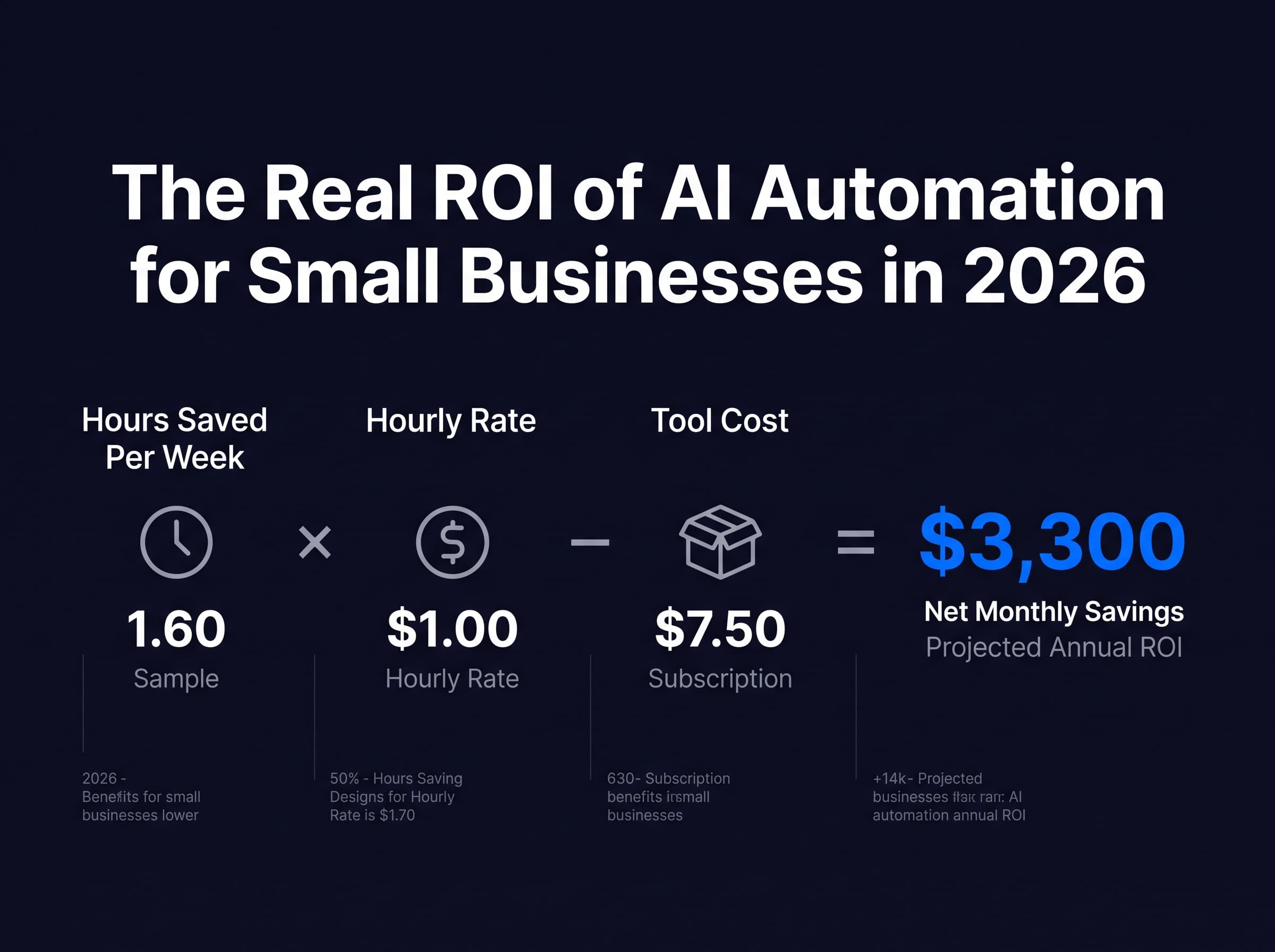
The formula is straightforward:
- Hours saved per week multiplied by hourly rate equals weekly value
- Weekly value multiplied by 52 equals annual value
- Annual value divided by annual tool and implementation cost equals ROI multiple
A business automating a workflow that saves 5 hours per week at an effective rate of $80 per hour generates $20,800 in annual recovered time value. If the automation costs $1,200 per year to run, the ROI is approximately 17x.
They Start With One Workflow and Prove It Before Scaling
The businesses that reported failed automation implementations in 2026 surveys share a common pattern: they tried to automate multiple workflows simultaneously, spread implementation effort too thin, and ended up with several partially working systems that required constant maintenance.
The businesses that reported strong ROI started with one workflow, ran it in production for 30 to 60 days until it was reliable, measured the actual results against the baseline, and only then moved to a second workflow.
Patience in sequencing is the most underrated factor in automation success.
The Payback Period Data by Workflow Type
Different automation types have meaningfully different payback timelines based on 2026 implementation data.
- Micro-automations such as a simple connection between two apps, a single prompt chain, or a support macro have payback periods under 60 days. Tool cost is small, implementation takes a weekend, and the hours reclaimed compound immediately.
- Workflow automations covering intake processes, scheduling, content production, and lead qualification have payback periods of 2 to 6 months. This is the category where most small businesses should start because the scope is manageable and the ROI is clear.
- Departmental systems covering full marketing operations, sales enablement, or support deflection have payback periods of 6 to 12 months due to longer integration and change management timelines.
Small businesses save an average of $7,500 annually from AI workflow automation. 25% of adopters save over $20,000 per year.
The Workflows That Consistently Fail to Deliver ROI
Not every automation produces a positive return. The 2026 data is clear on the workflow profiles that consistently underperform.
- Low-volume tasks do not produce enough recurring time savings to justify the implementation investment. If a process happens twice a week and takes 20 minutes each time, the math rarely works unless the implementation is extremely simple.
- Highly variable processes where inputs change significantly month to month require constant prompt and logic updates that consume the time the automation was supposed to save.
- Processes requiring genuine human judgment — vendor evaluation, negotiation, creative direction, complex customer relationship management — produce poor results when automated because the automation cannot replicate the judgment that made the process valuable.
- One-off generative experiments without a defined repeating workflow produce impressive demos and no measurable ROI. A prompt that generates a one-time report is not automation. It is a single AI-assisted task.
How to Calculate Whether a Specific Workflow Is Worth Automating
Before building any automation, run this four-step check.
Step 1 — Measure the current cost. Hours per week multiplied by the effective hourly cost of the person doing it. If the answer is under $200 per month, the economics are marginal for most workflow automation implementations.
Step 2 — Estimate the realistic time saving. Industry benchmarks put this at 30 to 50 percent for well-scoped workflow automations. Be conservative. 30 percent is a safer planning assumption than 80 percent.
Step 3 — Estimate the tool and implementation cost. For n8n self-hosted workflows, the ongoing cost is primarily API calls to LLM providers. Budget $20 to $80 per month depending on volume and model choice.
Step 4 — Divide annual savings by annual cost. If the multiple is below 3x, the workflow is marginal. If it is above 5x, it is a strong candidate to build immediately.
For practical n8n workflow templates that have been tested in production for each of the high-ROI use cases above, visit autonobots.estorealm.com.
Frequently Asked Questions
How long does it realistically take to see ROI from an n8n automation?
For focused workflow automations built on n8n, payback periods of 2 to 6 months are typical for small businesses. The fastest paybacks come from high-volume repetitive tasks like invoice processing and support triage where the time savings are large and immediate. More complex integrations take longer but tend to deliver larger absolute savings.
Is the ROI from AI automation mostly from time savings or from revenue increase?
Both contribute but the proportion varies by workflow type. Administrative and operational automations deliver ROI primarily through time savings and error reduction. Customer-facing automations such as lead nurturing, support response, and personalized outreach deliver ROI through both time savings and measurable revenue impact. Marketing automation specifically averages $5.44 returned per $1 invested, the highest return of any automation category in 2026 data.
What is the most common reason AI automation fails to deliver expected ROI?
The most common reason is automating a process before fully understanding it. When you do not know every edge case, exception, and failure mode of a manual process, you cannot build an automation that handles them. The businesses with the best ROI outcomes mapped their manual process in detail before writing a single workflow node.
Should a solo operator prioritize different workflows than a small team?
Yes. Solo operators benefit most from automations that extend their effective working capacity — research agents, content distribution, and report generation that produce outputs they could not produce manually at the same volume. Small teams benefit most from automations that reduce coordination overhead — lead routing, meeting notes, status update generation, and anything that currently requires one person to manually hand off to another.
Does self-hosting n8n meaningfully improve automation ROI compared to using n8n Cloud?
For high-volume workflows, yes significantly. The per-execution cost on n8n Cloud can accumulate meaningfully at scale. Self-hosted n8n has zero execution cost regardless of volume, which changes the ROI math substantially for any workflow running thousands of operations per month. The tradeoff is the one-time setup cost and ongoing server maintenance, typically 2 to 4 hours initially and under an hour per month.
This article is for educational purposes only. ROI figures cited are drawn from published industry research and vary significantly based on implementation quality, workflow type, and business context. Verify claims with the original sources before making investment decisions.
More from Autonobots
The 5 Automation Workflows Every Business Should Build First in 2026
Not all automation workflows are equal. These five have the highest documented ROI, the clearest implementation path, and the fastest payback periods of any automation a business can build in 2026.
The Multi-Agent System Architecture Every Builder Needs to Understand in 2026
Single agents hit a ceiling. Multi-agent systems — where a coordinator delegates to specialized workers — remove that ceiling. Here is the exact architecture and how to build it in n8n without custom code.
The next autonobots essay in your inbox.
One careful letter, every Sunday. Free.