Single agents hit a ceiling. Multi-agent systems — where a coordinator delegates to specialized workers — remove that ceiling. Here is the exact architecture and how to build it in n8n without custom code.
Why Single Agents Hit a Ceiling
A single AI agent with a complex goal, many tools, and a long system prompt consistently produces worse results than a team of specialized agents each handling a focused subtask.
The reason is attention and context distribution. When a single agent has twelve tools and an ambiguous instruction set, it distributes its reasoning across too many possibilities. It makes suboptimal tool selections. It loses coherence on long tasks. It returns mediocre results on each subtask because it was never fully focused on any one of them.
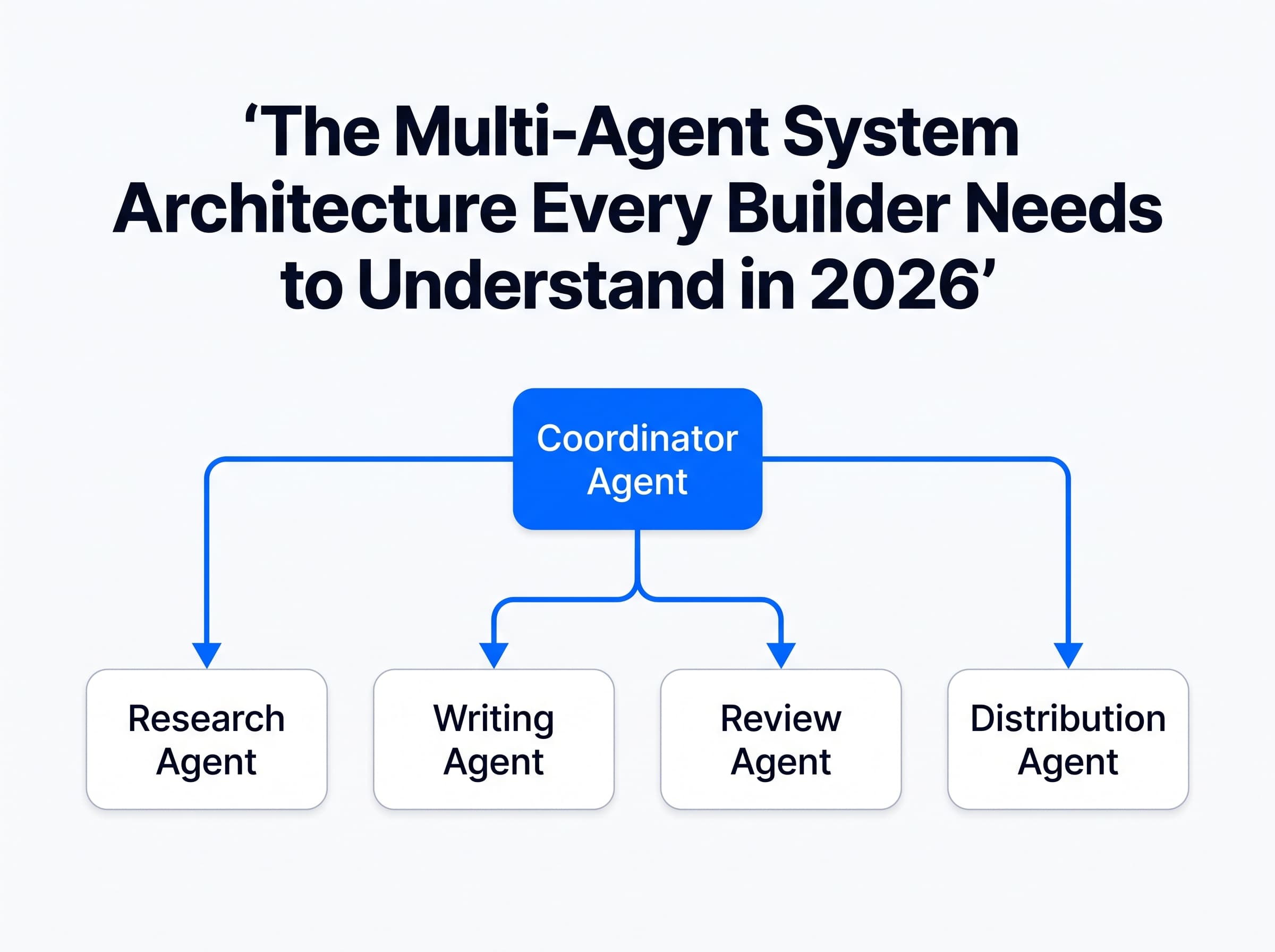
The multi-agent architecture solves this by applying specialization. A coordinator agent receives the high-level goal and breaks it into discrete subtasks. Specialized worker agents each receive one focused subtask, have access to only the tools relevant to that task, and return a structured output. The coordinator synthesizes the worker outputs into the final result.
This is the orchestrator-worker pattern, and in 2026 it is production-reliable in n8n.
n8n now has 196,800+ GitHub stars and 200,000+ community members — making it one of the most widely deployed self-hosted automation platforms for AI agent orchestration.
The Three Multi-Agent Patterns You Need to Know
Pattern 1: Orchestrator-Worker
The most widely used pattern. A central coordinator agent receives the goal, breaks it into subtasks, delegates each to a specialized worker agent, and synthesizes the returned outputs.
Example: a content production system where the coordinator receives a blog topic and delegates to a Research Worker (web search and source gathering), a Writing Worker (long-form article generation from the research), a Review Worker (fact-checking and quality assessment), and a Distribution Worker (platform-native format generation for each channel).
Each worker has a tight, focused system prompt and access to only the tools it needs. The coordinator has no tools of its own — its only job is routing and synthesis.
Pattern 2: Sequential Agents
Each agent in the chain performs its specialized task and passes its output directly to the next agent as input. There is no central coordinator — the workflow is a linear pipeline where the output of each stage is the input of the next.
Example: a lead processing pipeline where an Enrichment Agent gathers additional data on an incoming lead, a Scoring Agent assigns a priority score based on defined criteria, a Routing Agent determines which team member should receive the lead, and a Notification Agent sends the personalized outreach message.
Sequential patterns are simpler to build and debug than orchestrator-worker patterns. They are the right choice when the task has a clear, fixed order of operations.
Pattern 3: Parallel Agents
When subtasks are independent of each other, running them simultaneously rather than sequentially reduces total execution time dramatically.
Example: a weekly competitive intelligence report where four research agents each monitor one competitor simultaneously, then a synthesis agent combines all four outputs into a single comparative briefing. Total execution time is the time of the slowest individual agent, not the sum of all four.
In n8n, parallel execution is implemented using the Split In Batches node to fan out to multiple agent branches and a Merge node to collect all outputs before passing them to the synthesis step.
How to Build an Orchestrator-Worker System in n8n
Step 1: Design Before You Build
Map the full task before opening n8n. Identify:
- The high-level goal the system needs to accomplish
- The distinct subtasks that goal can be broken into
- The specialized expertise and tools each subtask requires
- The output format each worker needs to return for the coordinator to synthesize effectively
The quality of this design step determines the quality of the entire system. A poorly decomposed task produces a system where workers overlap, return incompatible outputs, or cover gaps that were never assigned to anyone.
Step 2: Build and Test Each Worker Agent Independently
Build each worker agent as a separate workflow in n8n before connecting them to the coordinator. Test each one independently with realistic inputs until it returns reliable, consistently formatted outputs.
Workers should return structured outputs — a JSON object with clearly named fields, or a Markdown document with a defined section structure — rather than free-form prose. Structured outputs make the coordinator's synthesis job reliable because it knows exactly where to find each piece of information in every worker's response.
Step 3: Build the Coordinator Agent
The coordinator agent's system prompt has two jobs: decomposing the incoming goal into subtasks, and synthesizing the returned worker outputs into the final result.
In n8n, you call each worker workflow from the coordinator using the Execute Workflow node. Pass the subtask instructions as input, receive the worker's structured output as the return value, and continue to the next worker or to the synthesis step.
The coordinator should not have any tools beyond the ability to call worker workflows. Any tool access it has creates the same attention distribution problem that the multi-agent architecture was designed to solve.
Step 4: Add Error Handling at Every Layer
Multi-agent systems have more failure points than single-agent workflows. Each worker is a potential failure point. The coordinator itself is a potential failure point. The connections between them are potential failure points.
Every worker workflow should have its own Error Trigger connected to an alert. The coordinator should have logic to handle the case where a worker returns an error rather than propagating that error silently to the final output.
A robust multi-agent system logs every worker's output alongside the coordinator's final synthesis so you can audit exactly what each agent contributed to any given result.
The System Prompt Architecture That Makes Workers Reliable
The most common multi-agent failure in 2026 is not architectural. It is system prompt quality.
A worker agent with a vague system prompt produces inconsistent outputs that the coordinator cannot reliably synthesize. A worker with a precise system prompt returns structured, predictable outputs every time.
Every worker system prompt should specify:
- The agent's exact role and the specific task it is responsible for
- The exact input it will receive and what each field means
- The exact output format it must return, down to field names and data types
- What to do if the input is missing, ambiguous, or outside its scope
- What the agent should never do or include in its output
The last two points are consistently omitted in first-attempt multi-agent builds and consistently account for the majority of production failures when they are missing.
When to Use Multi-Agent vs Single-Agent
Not every automation benefits from multi-agent complexity. The additional architecture has real costs: more workflows to maintain, more potential failure points, more system prompt surface area to manage.
Use a single agent when the task is well-defined, the context is bounded, the required tools number fewer than four, and the full reasoning can happen in a single coherent pass.
Use a multi-agent system when any of the following are true:
- The task has distinct phases that require different expertise or tools
- The total context required exceeds what a single agent can manage effectively
- Parallel execution would meaningfully reduce total runtime
- Quality review of one agent's output by another agent is required before proceeding
- The workflow needs to handle a high volume of concurrent tasks
For complete n8n workflow templates for each of the three multi-agent patterns above, including coordinator system prompts and worker configurations, visit autonobots.estorealm.com.
Frequently Asked Questions
How many worker agents is too many in one orchestrator-worker system?
In practice, three to five workers per coordinator is the productive range for most use cases. Beyond five, the coordination overhead and the complexity of synthesizing outputs reliably begins to offset the benefits of specialization. If a task seems to require more than five workers, consider whether it should be broken into two separate multi-agent systems with a higher-level orchestrator connecting them.
Can worker agents call other worker agents in n8n?
Yes. Nested agent architectures where a worker agent is itself an orchestrator for a sub-layer of specialized agents are possible in n8n using the Execute Workflow node at multiple levels. This pattern is appropriate for very complex tasks but adds significant debugging complexity. Build and test each layer independently before connecting them.
What is the difference between parallel execution in n8n and running multiple separate workflows?
Parallel execution within a single workflow using Split In Batches and Merge nodes keeps all branches within one execution context, making error handling, logging, and output synthesis cleaner. Running multiple separate workflows achieves the same parallelism but requires external coordination to collect outputs. For multi-agent systems, keeping parallel workers within a single workflow execution context is generally simpler to manage.
How do I pass context from one worker to the next in a sequential pattern?
Use the output of each worker node as the input to the next worker node directly in the n8n canvas by connecting the output socket of one Execute Workflow node to the input of the next. Include the previous worker's output in the next worker's input payload under a clearly named field. The receiving worker's system prompt should explicitly describe what to do with that context.
What is the most reliable output format for worker agents to return?
JSON with explicitly named fields is the most reliable format for programmatic synthesis in the coordinator. Markdown with a defined section structure using ## headers for each required section is the most reliable format for human-readable synthesis. Choose based on whether the coordinator needs to process the output programmatically or generate a human-facing document from it.
This article is for educational purposes only. n8n features and multi-agent patterns continue to evolve. Verify current node availability and configuration in the n8n documentation.
More from Autonobots
The 5 Automation Workflows Every Business Should Build First in 2026
Not all automation workflows are equal. These five have the highest documented ROI, the clearest implementation path, and the fastest payback periods of any automation a business can build in 2026.
The Real ROI of AI Automation for Small Businesses in 2026 (With Actual Numbers)
AI automation delivers a median 300 percent ROI over three years for businesses that implement it well. But 20 percent of adopters capture 75 percent of the gains. Here is what separates the winners from everyone else.
The next autonobots essay in your inbox.
One careful letter, every Sunday. Free.